2010-07-21

The golden rule

I remember that when I was about 20 and had a philosophical crisis, one of the most asked questions to myself (and others) were:
What should I do?
How should I treat my neighbors?
How should I do this or that?
You could spend ages answering these questions and there are plenty of books written trying to answer these questions, but there is a simple rule of thumb:
Behave the same way as you would enjoy to see everyone else behaving.
Or (in other words):
Treat others as you would like to be treated.
This applies to:
  • How you treat your family, friends, neighbors and foreigners,
  • How you do your work,
  • How you treat your environment,
  • and more
Examples:
  1. Don't kill others if you don't want to be killed.
  2. Don't drop waste in front of your neighbors house.
  3. Don't lie to people.
  4. ...
Instead of thinking too much before you do, just feel, what is best.

More information on the golden rule on Wikipedia.

Related posts: The main purpose, Something more important, Focus by direction, Razor sharp focus, Direction over goals, Principles over rules, The value of experience, Replace constraint with freedom, The family, Considerations on decisions.

2010-06-22

The value of experience

A few months ago at a local conference a talk was introduced with the quote
"Good judgment comes from experience.
Experience comes from bad judgment.
"
~ Jim Horning
In the meantime I noticed a lot of cases where the importance of experience was simply ignored - e.g. with hire and fire or outsourcing strategies of companies.

And today I stumbled again over this quote at 3 secrets to Financial Success.

Along with the ignorance of experience often comes the ignorance of how important knowhow in general is.

The importance of experience comes from the fact that in most cases experience is something gained over a long time with a lot of effort involved!

You can learn only to some extent from the experience of somebody else.

Related posts: People's history, Transferable knowhow, Fool me once..., Know better and act on it, Information and experience, The golden rule.

2010-06-18

The resource problem

I got a lot of my moral education from Star Trek. I often thought that they give a good example on how people in the real world should treat each other. - And I wondered why it is so hard to implement and evolve similar constructions in the real world. In (at least) one episode it was mentioned that people like to work for self esteem and other higher interests than "just" money or only because they are forced to work.

While being on the way to implement some core ideas there is an important thing that the whole trilogy and series are leaving out: The resource problem.

I thought of the resource problem several times and always it came down to be a population problem. If there would only be 100 humans on this earth environmental pollution would not be a problem. 100 humans could hardly produce a critical amount of pollution even if they do take a hot bath for 5 hours each day and drop metal cans wherever they stand. They could move on to another place and not return for the next thousand years and then everything of the waste will be gone anyway.

But this is a non-realistic situation from current point of view. The resource problem is getting more and more critical as we are not only exhausting our planet - no, we are destroying at the same time to make sure that while consuming one resource others are ruined too.

While the resource problem is a major problem that causes war and litigation it also can help avoiding wars or bring them to a faster or "better" end. This, because global playing companies are interested in making money from the resources which usually means that the country where the resources are need to have a government and population that is stable and in peace. That said, the war is then not fighted out with weapons but with money.

Economic (money) war is still war somehow and poverty is the slow death of those who got shot out of the game.

The fear of personal or economic death let people focus on their personal revenue to ensure their survival. There must be a really big change in a lot of realms to get an overall common peaceful and cooperative attitude! - Solving the resource problem is one of them!

That also implies, that if you want to have long term peace and people really working together (in the way that they really help out each other), you have to ensure that all the members (of the world, your team, your company, ...) have the chance to get enough resources to make their living.

What applies to the world also applies in the small - for your family, your team, employees etc! So think big, start small and be humble!

Related posts: Finding the proper priorities, Ethic economy, An eye for an eye, The power of intention, Scotty - beam me up..., Inequity, Hunger and poverty, Television.

2010-06-15

Root of responsibility

A while ago I have seen the video of Eckhart Tolle about responsibility. He says that responsibility is not what we do, it is who we are.

I am not sure if he is 100% right, I would rather say: The basic disposition of responsibility is founded in the who we are. We could also be urged by others to take responsibility. If somebody breaks a Window he could be forced to repair it (or pay somebody who repairs it) - so there can be an action of taking responsibility without the appropriate state in mind that wants to proactive contribute good stuff to this world.

But there is no doubt that the most effective way of positive contribution to our world is the appropriate change in our core being. It is always better to solve problems at their root and not trying to close thirty leaks that all spring from the same source.

These thoughts do apply not only to responsibility and it goes further. For example if we want to be loved by others we should love the others and the best way to achieve this is BE a loving person. And meant is having the positive wish for others in mind. This may include a force to hold somebody back doing harmful things...

Nowadays many people fear about saying their opinions officially (on the web) or stand up against obvious wrong decisions (by government for example). Falling into fear and avoiding action is clearly not a way to turn the world into good and not a way to develop responsibility.

Related post: Guarantees and responsibility.

2010-05-13

Guarantees and responsibility

Yesterday evening I watched a TV discussion about the crisis in Greece and regarding the Euro currency.

I was really wondering how they can talk about guarantees given on financial dept with amounts like billions of Euros when in reality the countries do not have that money. It is impossible that the whole European Union has that amount of money. If the EU or single countries would have such amounts of money, it would mean that they robbed the people living there or that they robbed other countries.

Or could it be, that they have a guilty conscience because they robbed the poorer countries in the past?

However, it seems that nearly every european country has big depts. While being in big dept, giving guarantees in huge amounts of money to me seems extremely weird.

When I remember the last company affairs that were in the news, appropriate responsibility often was just that the just managers stepped back. Or look at the oil leak at Gulf of Mexico. I can hardly believe that anybody really can take the responsibility (if somebody really would). People try to attach amounts of money to such damage, but I think that nobody in the world can really repair what happens there.

In the same way I have problems with the imagination that years and years of misgovernment and maladministration can be repaired by giving guarantees of fantastic amounts of money.

The irresponsible behavior of people must be stopped and prevented in its roots! The huge collateral damage can't be healed years after.

That would prevent from huge damage in the future but still does not repair the pile of broken glass we already sit on.

What I learned from the TV show yesterday is that I have to analyze carefully, if somebody gives me a guarantee on anything.

Nowadays guarantees are given so fast and easy, sometimes it looks like bare fraud.

Related posts: Inequity, Hot air, Root of responsibility.

2010-04-09

Minimum effort

I remember that my most creative times were when I had much time available for thinking, trying something out and philosophying about the future and experiences from the past (BTW: these were the days prior to having a family and especially those times where the relationship with my wife was a long-distance relationship because I had plenty of "free" time I could dedicate to my work ;-) ). Later on, when I was already married it happened that I had to travel a lot in car with colleagues. The communication / discussions we had there also lead to a lot of creative solutions.

These times are definitely gone for me. There is productivity pressure. More has to be achieved with less effort/time/money. And I can see similar at a lot of other places. People want to make more cash with less effort or people want to get more for less money.

One thing I wonder is, why pressure is not just happening due to bad planning but also continously used as a strategy to get the most out of the working crew. I already wrote about parkinson's law several times what I think of it - basically causing impact on quality. The only positive aspect that probably has been the original intention is to cause productivity optimization in the way that the workers find the easiest implementable solution that shows the biggest effect.

But guess what: Working always with the minimum possible effort in mind, you can't achieve really outstanding and big success. I don't mean that for each step in a big project you shouldn't search for the most efficient way to solve the problem. Applying this principle to a project as a whole you end up finding the easiest and not the best solution - and there might be a huge difference in the overall benefit and even in the return of investment. I think, when building the pyramids, they didn't thought of the easiest solution but for the best quality solution.

And with trying only the quickest and easiest approaches companies either might not win big advantages over competitive vendors...

Related posts: Parkinson's law and quality, High quality needs time, Economy forecast, Urging to forge at full speed.

2010-03-29

Productivity limits

In the last weeks I have worked at 100% - I have slept not more than 3 to 5 hours but needed to fully concentrate during the day and nights. In between I was on full speed handling children or parts or other work in the household or somehow related. - A reason why I did not post here for a while.

This works for some weeks but then it comes to an end. The last days it was already very difficult to concentrate and be productive. Fortunately I had a deadline to be kept so I did know exactly how long my energy must last.

So my important advice for employees: If you need to work extra hours, make sure that it is for a limited time only. Know the goal, mission and see the end. Example: If a colleague has left the company and your boss is not going to fill the gap expecting you to do the work from now on working more then this is not such a situation (assuming that your normal work is not reduced at the same time)! - Effect: You will loose power and at the final end although working more hours your boss will complain about less productivity.

Important advice for companies: Know, that your employees have not everlasting batteries. Massive extra hours should be reserved for emergency! This should not be a normal situation! The power of your employees will get less and hence productivity, creativity and they/you will have no more flexibility to adapt in emergency cases. Even if you try to hide it, somehow your customer will notice due to reduced quality, slower response times etc.

Related posts: Parkinson's law and quality, Stop the service, Reduce the stress factors.

2010-02-10

Living your opportunities

The problem: The gap between what you are and what you would like to be.
When I was a little boy, I was day dreaming quite a lot. This was paired with optimism (my father told me that I was a very open and positive child) and lead to expectations a lot of times. The final effect often was a lot of suffering after disappointment. Especially last year I read so much about living your dreams and how you could be the most successful beast ever existed. A very common delusion is that everything is feasible. The reality shows that
  • only a very few people do have really big success,
  • very successful people are not always final winners at the end (some even end up in jail),
  • success (not only in form of money) often comes with the fear to loose it (if material success) or with the fear to get obsolete (invention, knowhow etc) and
  • people tend to never get enough of success (however they define it - it is subject to change).
Everybody wants to be successful and happy but only a few really get it.

The reason: Misuse and misunderstanding of success, hope, confidence, positivity and the like.
Success can be defined in many particular ways and often people dream something and are optimistic to achieve everything if they just want it strongly enough. And they are "doers" first. At the final end (or earlier) on the other hand they tend to redefine success of being that what they could achieve during their life. So at the beginning there was the dream and at the end there was reality. What needs to be developed is the control instance separating dreams and hope from reality and opportunities.

After failing a lot of times because of those mistakes I started switching to a pessimistic view. To save me from suffering when coming down to reality. I expected the worst to experience positive surprises rather than disappointments. Effectively this was the other extreme I could go without proper separation of those terms. But the root mistake was basically putting too many terms and elements of life into the same pot.

The solution: Be happy and choose opportunities.
A first thing is to redefine success as "being happy" (in long-term view). Don't accept others defining success or happiness for you. Look deep into your heart and personality. You might prefer looking after children over inventing a cool gadget or you might want to show others the world or you might want to contribute with good music to this world.

Second you need separation of terms: Love (for yourself and all your peers) is a base requirement for a positive life. Hope is a difficult word and I usually don't use it. But as used in many contexts I found it is best to see hope as an overall confidence that universe is evolving in the way it should after you did your contributing duty to make everything better. You should know that nothing tends to change in a direction you desire without you taking action to contribute appropriately. Faith can be the self-confidence, drive, energy and trust to get appropriate help where needed and asked for. Expectation can be the patience to wait for the results of your work (done with pure conscience) taking effect (whatever that will be) and the willingness to learn from it. Using these terms wisely leads to balanced positivity.

Last but not least: Keep your eyes and ears open. See the opportunities in your life but be aware that you can't choose them all. So select wisely your path and know that right and wrong cannot be seen absolutely - it depends on what can bring happiness into your life. Success is not necessarily being well-known or earning a lot of money.

Related posts: In the present moment, Success with optimism AND pessimism, How to be happy, Direction over goals, Principles over rules, The main purpose, Your situation does not suck.

2010-01-23

Best defense

I am thinking myself of being a peaceful guy. At the same time I believe to be a sincere person.

I realize that by being sincere it is hard to completely avoid creating aggression within others. But anyway, even if I try to avoid creating aggression at any cost, I can't. People are way too creative in seeing threats anywhere.

So solving the problem in the very beginning - by not creating aggression - is quite impossible. So one has to think about defense.

And the best defense is ... not be there (said by Myagi in Karate Kid).

I am quite sure that this is not always a convenient solution - not always feasible. But imagine people attacking you personally and imagine you are getting your self-confidence from somewhere else so the attack is not going to hurt you. Or imagine another company that is fighting you by producing cheaper than you. If you are innovative and can offer additional services or already newer, improved product then you moved to higher quality and the weapon of your opponent is simply obsolete.

Your first emotional action might be to defense yourself, your properties or your ideas even. Already the words "resistance" or "defense" come along with the feeling of effort and struggle. Getting yourself out of the fireline with a small step to side is often much more efficient and effective. Keep this in mind, before arming up for defense. However, when you know how to move out of the fireline you will also know when to stand up and fight - sometimes it can be necessary.

Related posts: An eye for an eye, Stop war by stopping defense, Little respect, Best wishes to all, Dissolved aggressiveness, The wise talk less.

2010-01-05

The productivity trap

The problem: Attempts to increase productivity and efficiency finally do not bring the big success.
When starting or pushing your personal development, strategies to increase productivity and efficiency are usually some essential parts. While it is important to find out where you waste time something is missing.

The reason: It is not the amount of work or the amount of results that counts.
It is not the amount (however you are trying to get your results into numbers) and neither the quality of the results that make things or people successful. Some people seem to do just one thing and have success.

The solution: WHAT to do and HOW to do is more important than the amount of things you achieve.
Imagine a person working hard to develop a new method to produce candles more efficiently and then the electric light bulb is invented and the candle sales go down drastically. This is the reason why industrial spying is undertaken by companies for example (at least I think this is a major reason). Because it is extremely important that you are doing the right things the right way!

And this means:
  1. Do good analysis
  2. Decide wisely on what to do
  3. Do it the right way (in the means of how it creates the best benefit for the user/customer)

Related posts: Razor sharp focus, Dynamic activity, Speed, High quality needs time, Get focused with 3 questions.

2009-12-31

New year decisions

Last year at this time I read a lot about new year's resolutions and why people mostly fail in implementing them.

Reasons why they fail are for example:
  • Lack of a step-by-step plan to implement (re)solutions.
  • Missing milestones/control/verification points (just once a year doing a check is not enough).
  • Bad analysis in why the old habits were there - implementing a new habit instead of an old one works better if the new habit is also solving the old problem(s).
  • ...
So the point is, that just from one day to the next you will hardly be able to change your life or your habit(s) respectively. The best approach for changing your life is to plan several different goals and step-by-step programs for implementation. But this is done mostly during "normal" - continuous - personal development.

Dedicating time to personal development just once in a year is clearly not fruitful.

But anyway I do consider the new year's eve a good opportunity to look back at the last year, build a summary and do some focus decisions for the next year. Writing the old year's number for the last times or writing the new year's number for the first times is somehow something special that let us feel a cesura - it causes us to pause for a moment or at least creates a good environment to do so.

It is the same as in project management: Milestones should not be too distant from each other. Points of control should be often enough to ensure you are on track but there should be enough time between to have the chance finish some implementation (attempts).

I find new year's eve not the best time to break with old habits as during the last weeks of the year most people tend to find more stress than less. Thinking about and implementing new habits for me works better during and after longer (summer) vacation.

On the other hand new year's eve for me is a good time to think about a (possible but not necessarily "new") focus for the next year and take some (maybe already overdue) decisions. This will help you in your daily decisions already in the first days of the year. Just having the desired focus in mind masks irrelevant information making your life easier. And it avoids making commitments that do not support your life plans but take effect later during the year (so you don't notice immediately).

I wish you a successful 2010 with good decisions and razor sharp focus.

Related posts: Razor sharp focus, Information overflow, Focus by decision, Focus by direction.

2009-12-19

Needs and Meaning

I did not write for a while due to several reasons. First I invested a lot of private time into building technical knowledge slightly different from my daily work. That held me back from writing more posts already earlier, but sometimes such is necessary if you want to grow - see also "Knowledge is freedom".

The second reason is the birth of our second son. Unfortunately after the first two weeks it turned out, that he has a tachycardia and needed to stay under intensive care. A few days ago we got him back home with medication and a heart monitor.

What I learned from this recently:
  • Luck, happiness and healthiness is fragile.
    When he was born I was so happy to have two sane children. Now I know how fast that can change. - I should already know this very well - everything is fleeting...

  • Replace worrying with real risk management.
    When situation is bad we are full of sorrows and when everything is fine we actually need to worry about our properties and health fading away. So we could spend our life worrying all the time or simply stop it because anyway it does not make anything better. This is not to be put together with not being aware! - We should be aware of potential risks and problems! We should do our best to act healthy and ethical! But plain worries focus just on all the possible bad results without real risk management and taking any action - so our day-to-day repeating worrying really does not make any sense.

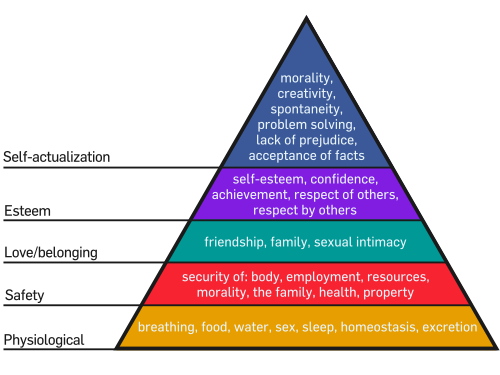
  • Maslow is quite right with the hierarchy of needs.
  • Viktor Frankl was quite right also.
    He has written about man's search for meaning and developed the logotherapy. He basically states that we can discover meaning in life in three different ways: (1) by creating a work or doing a deed; (2) by experiencing a value – nature, a work of art, another person, i.e., love; (3) by the attitude we take toward unavoidable suffering.

  • Be thankful for every help you get.
    Especially doctors often have a negative image, but they really can save your life (or in our case the life of our son).
Related posts: Biggest worries, Knowledge is freedom, The most important things to know, All done status, There is suffering.

2009-11-22

Biggest worries

One of my biggest worries always was to get the children born healthy and sane. Now, with the birth of our second child I am very happy and thankful that both are well.

Thinking of the family I do notice that it is extremely important to me that my loved ones stay well - healthy, sane and happy.

But the other very, very important thing mostly underestimated while everything runs (still) fine: Having a job is a key major need and doing a good job is the best insurance of keeping it.

Remaining without a regular work / day job is one of my key worries. It is a requirement to get settled with your family and have enough money/resources for food, roof, clothes and medical support.

The next biggest worry is that my loved ones get ill, rubbed or knocked down for example. I want to know them being sane and save. Having a good job and enough income is a key requirement to get everything needed for a living.

Although quite logical and most should know, sometimes I have the impression that people's life is so full of things that the most primary priorities lack attention...

Related posts: The most important things to know, Knowledge is freedom, Needs and meaning, The family.

2009-11-04

Knowledge is Freedom

You might have noticed that I currently do less posts on this blog lately. This is not due to less interest or that I don't have opportunities to learn general lessons of life. - The reason is: I am in a heavy upgrade of my knowledge in the branch of my main profession - the IT.

In relation to that I want to point out some general important considerations:
  1. Knowledge is creating/increasing job security!
    In a downturn many people fear to get laid off. People with a high level of knowledge simply have a higher value for a company (if the knowledge is not just focused in a very limited area - although even this can make sense).

  2. Knowledge is creating more options!
    Expanding your knowledge is opening your mind to other - new - things in general. Especially when gathering knowledge in other (completely) new areas you get a more complete view of the world. You begin to see more and more options: More options to solve a single problem, more job opportunities, more benefits and even risks - that all helps you to find your way in life that fits best for you.

  3. Knowledge is boosting creativity and efficiency!
    Especially when you get more knowledge in very different areas of life you are increasing your creativity because of the linking of different approaches taken in different branches or areas. For instance physicians often look at biology to find more efficient solutions in their realm. By getting more creative you also find better options for using your time efficiently.

There are some side effects of knowing much that you may like, such as:
  • When learning you have the opportunity to get in touch with other people.
  • Your opinion is appreciated when people begin to notice that you know much.
  • You get more self-esteem and feel more inner security.

Some of the challenges are:
  1. Work-Life-Balance
    To get more knowledge often implies that you have to gather that outside of your daily job - in the evenings, nights or early mornings. While the family can often understand that for a while, you most likely get into trouble, if it gets usual that you spend your spare time more working than dedicating to your family.

  2. Overwhelming amount of knowledge
    The more you know the more you get aware how tiny your knowledge is. There is not enough time to gather and learn all available knowledge (not talking about the not-yet-available knowledge). So: You have to choose wisely what to learn to not waste your time!

  3. Efficiency in learning
    There are several different approaches to learn something new: Read books, ask experts (coaching), take courses, play around and try (experiment), ...
    Attending a course is not always the wisest choice, especially if you want to offer a unique service or product as a follow-up. In many cases, if you want to be at the frontline of some new technology or movement there is either not much offer in courses or books.
Related posts: The most important things to know, Transferable know-how, Hunting for degrees, Information overflow, Show respect to the team, What to learn from the Borg, Biggest worries, Needs and meaning, Know your options.

2009-10-28

Peoples history

It happens so easily that we label other people being idiots or behaving in a strange way. A broad minded way of looking at others is often missing and we are often not very "fault-tolerant" when it comes to our social living.

Just to give an example: How often does it happen that you drive by car and find yourself arguing about others in front or behind you doing stupid maneuvers?

Usually we look at people (or even on everything else also) in a quite limited way. While labeling others we put our own limited view and experience onto them and on this poor base we start with heavy interpretation and wild guessing.

But we usually know very little to nothing about the personal history and experience of others (even of our friends and neighbours)!

Prior to labeling and criticizing others we should do a lot of listening and asking for reasons! Maybe we can learn a lot!

Related posts: Crappy Guesswork, The value of experience.

2009-10-15

Ice Age

When I heard Al Gore talking about the global warming a good while ago (therefore I can't find the link again of that particular talk), something that kept being on my mind since then is:

While he was explaining world history, melting of ice and the increase of temperature he also mentioned that a next step (talking in millions of years) after a global warming is an ice age.

So, if we do now have have to expect a global warming of a size and speed that never has happened before in world history - couldn't it be possible that the next step is following as fast?

If I think of control engineering and if I would be able to control the world, what would I do NOW? - Knowing that people created massive reasons for global warming, I would do everything to cool down the world. - Al Gore mentioned that after global warming the typical way weather happens then change and all the ice is rebuilt (not only on the poles). So if I would be mother nature I would already in advance do some change to advance too much of global warming.

When people talk about global warming I often get the impression that people believe that world reacts very slowly to all changes and is always behind. I don't think that changes in the world are always just lacking behind.

What, if the triggers for the next ice age already have been initiated? What if our massive contribution to causes of global warming are already also triggering the next ice age in the same speed?

2009-10-04

Being like a child

In personal development blogs I read a lot about being like a child increases creativity and happiness for example. I have also seen people having serious psychological problems when growing up and facing an increasing amount of worries.

Indeed, when remembering childhood I can recall fewer worries than later on when in a relationship, in business world or after starting a family. But the point is that there were not less reasons to worry when I was a child. I was just not aware of them! - I could have worried about my future job, if I would earn enough money to keep my family fed and so on. Growing up I got aware of more and more things that can go wrong, more and more important decisions that could be life changing.

Returning to be like a child for me in some way would seem like just fading out most of the worries I am now aware of. And in fact some people when facing themselves in the middle of job, family and future worries, get into midlife crisis or just put their had in the sand (or their nose into the alcohol or whatever).

The blogs or people recommending to return being a child do mean particular properties that children usually have, such as curiosity, being themselves (what they say and do fits together), worry less etc. - But I think that you can't tear these things out of context. You usually can't do something experiencing just the positive and not the negative aspects that come with your decision. For example: With the comfort of going by car you have to refuel it which costs money. Or a more related example: "The all done status" - I am usually the more happy the more I feel that I have the impression that all my duty has been done. I had that impression much more often in childhood than nowadays. But in reality there were a lot more things uncertain and not finished in those times. I just did not know. I could have said that it is just not the right time for more - but I could have done more to be well prepared for life. And what holds me from saying that now - "it is not the right time for more"?

They say, the wise people are again more like a child. I think the key does not lie in the intention to return to childhood. I think the key lies in mastering the uncertainty and worries by surpassing a certain level of wisdom. Others will then notice a light heartedness known from childhood but the background of such wise people must be completely different.

Sometimes an effect cannot be reached by just focusing on the desired effect, because the effect is created in a totally different way. As a sample I think it is very hard to achieve lasting happiness without knowing what real suffering is.

Related posts: All done status, How to be happy, Highly happy people, There is suffering.

2009-09-09

About management

In these times at least some companies do recognize that it is important to have enough Indians to do the work. In the last years many have grown too big in administration and increased the amount of chiefs in favor of operators.

And especially the managers often eat up the most of the money a companies earns. But I guess even more money is wasted when performing big mergers that go along with a rebranding.

Another observation reveals that most people are somehow managers. A person that cleans up the room is treated as "facility manager". Sounds good, isn't it? - Well, my special honor goes to everyone who does a hard and dirty work, they don't need to be any form of manager to get my respect. Everyone who does a good work has my full respect for that. My doubt is that many companies do "job rebranding" to attract people. For a job (title) that supports (self) esteem people may also accept a lower income and therefore this might be a good strategy of companies to save money. And further there are a lot of jobs that only a few people accept to do.

The very strangest thing that my experience shows is that although everywhere it is full of managers, it seems that since economical crisis started (or even already before) many services are not provided in the quality any more that I got used to. The efficiency in many places seem to go down instead of getting better.

I think the reason is that calling every action being management and calling everyone a manager does dissolve the whole meaning of management. Real good management may already be absent in many places.

Luckily as long as Wikipedia and other sites are around we can be full of hope that the important knowledge of management does not get lost. From Wikipedia about management:
Management in all business and human organization activity is simply the act of getting people together to accomplish desired goals and objectives. Management comprises planning, organizing, staffing, leading or directing, facilitating and controlling or manipulating an organization (a group of one or more people or entities) or effort for the purpose of accomplishing a goal. Resourcing encompasses the deployment and manipulation of human resources, financial resources, technological resources, and natural resources.
If you look at this definition you notice that management is an activity that requires
  • having a very good overview of the whole thing that is being managed
  • good social skills
  • good organizational skills (many think that this is something you get automatically when getting adult but this is not necessarily the case)
  • ability to resolve conflicts
  • accounting skills
  • ...
A good manager must be able to do accounting (at some level) and even must be half a psychologist (I talked to a manager who told me that sometimes it is also necessary to help employees to solve their private problems to get them productive again).

Management is important to have a company working efficiently! While reducing number of managers in the downturn it is important to increase or at least maintain the quality level in management.

It is important to have as many Indians for the war as you can feed but it is important that they are motivated and run against the right target(s)!

Related post: Management by Customer.

2009-09-01

Speed

Imagine the situation: There is a dog dropping. A women is approaching in bicycle and in the hand holding even a plant. She does not notice the waste and drives right through.

I walked slowly instead and noticed it long before.

What to learn from this?

Beware of your speed! - Whatever you do, whatever decisions you are about to take, keep in mind that being too fast is a bad idea - it drives you right through the mess!

Taking decisions too fast without watching and evaluating the situation or operating too fast reduces the quality of your output. Take into consideration that with every mess that you produce you are not only failing to achieve the goal, you are creating additional work for you - needed to clear up the mess.

Again I do remember what the doctor told me:
Nobody is dying within 60 seconds. You always have at least 60 seconds for analyzing the situation doing nothing. (There might be some exceptions, e.g. when a very lot of blood is extruding around.)
When the patient has got a medicine in a dose somewhat too high trying to get back equilibrium might be difficult.

Should this not be enough to calm us down?

Related posts: Slowing down, Transferable know-how, Reduce the stress factors, How to instantly change a habit, The productivity trap.

2009-08-21

Transferable know-how

Lately I had a discussion about the value of particular experiences. Many people had been laid off because their particular and very specific knowledge was not needed any more.

It has been a longer while ago when I watched a video of Nathan Myhrvold - watch it yourself here (length 17:14). For me this is a very good example (if not the best) that you can apply knowledge and experience you gain in one realm onto completely different subjects to find creative new solutions or bring additional value into foreign areas.

It can an immense opportunity for a company hiring people with a broad experience on different areas - and it is a primary productivity boost if you are able to learn quickly from experience and find out different realms where it can be applied.

Another example: I talked to a doctor where I go to the gym. He has more than 20 years of experience at the intensive care unit in different hospitals. He told me that many times nurses called him being totally in panic because of emergency and he learned to take himself 60 seconds of time looking at the situation and analyzing. He said: Nobody is dying within 60 seconds. You always have at least 60 seconds for analyzing the situation doing nothing. (There might be some exceptions, e.g. when a very lot of blood is extruding around.) His experience is that doing "something" (in panic) often makes the situation becoming worse. If an injection is set, it's in and if it was the wrong action or just the dose was too high then you suddenly have to deal with two things running out equilibrium. He said, in 90 percent of the cases a slight adjustment was sufficient. Slight adjustment can be worth more than big rough action. I think this could be for example applied perfectly to IT emergencies also - as well as for a plenty of other situations too.

And while talking about knowledge being applied on other issues under different circumstances, I see that the knowledge from different other areas can help you in fitting your solutions to the rest of the world. I think, especially the wise men/women are particular good in re-utilizing knowledge.

I always tried not to get stuck looking just at my programming code, I always looked for the link to the customer real needs and kept an eye on overall efficiency and productivity. And I wish I had better listened to the other subjects in school too - even those which did not interest me at all. There are so many things you can learn from animals, from physics, from history etc - knowledge that can be useful while thinking of solutions for your daily issues. Testing knowledge and experience on different realms can boost your personal development (BTW: A boar is running faster than Bolt - maybe you should learn running from the boars ;-) ).

Keep your eyes open, learn, be creative and test on reality!

Related posts: Unwanted creativity, Speed, Knowledge is freedom, The value of experience, Prudential innovation.