Showing posts with label Priorities. Show all posts

2013-12-27

Considerations on decisions

Investigating situations where precious time is lost, I often find decisions being a core issue. Although we are taking decisions quickly and on a daily basis (many of them even automatically without being really aware of them) some of those can evolve to a very time consuming process.

Very often when we are in a dilemma we only think of this or that (black or white) and that's one of the mistakes. In many cases there are more options available than you might think of in the first place.

A second mistake lies in the effective time when the decision needs to be taken. While some people tend to delay a decision as long as possible (missing the best opportunities), others decide too early when not enough information is available or too few options have been elaborated yet.

So when a situation is evolving to a point of decision think of the following:
  1. Enough options elaborated? - Having only one option is dangerous (to do something or do not already requires a decision). If other people are involved then think of what their needs may be and try to find a win-win-solution.
    An example: I remember that my father sometimes had to go to the office on weekends but he also wanted to spend time with me. Well, he took me with him and showed me his working place. I remember quality time with my father when he showed me the big computer there and I was very impressed - and it made me choose my profession.
     
  2. Is it the right/best time to make the decision? - Did you gather enough information yet, that allows to make serious and good decision? Do you really need to take that decision NOW?
    An example: Buying a new computer or car. First thing to be aware of is: Do you really need to buy it NOW (is your old broken or not)? How much time for evaluation would be adequate for the size of the investment? Are you on top of the information? If you are in car or computer business respectively then the time for gathering information will be much shorter, otherwise you should maybe consult a friend who is.
     
  3. Do you really need to choose? Is there really a decision required? Sometimes you do not need to choose one thing over another as occasionally you can get both. Be aware of options that may get you both!
    Example: If you like black and also like white what about buying a shirt that has black and white stripes?
     
  4. (Re)think your core principles, values and priorities. When you find yourself often in dilemmas of the same type, you might improve the decision process by reviewing your core life principles, your core values or your (current) priorities.
    An example: A long time ago I often fought with myself to do something fast or good. I finally decided (of course after suffering a lot from consequences) to go for quality and prefer quality over fast results. Now many decisions of that kind are taken automatically in my subconscious part of the brain. Of course that might not always be the optimum way and I do also choose the quick fix from time to time. But wherever a fast decision process is needed the gut feeling will tend towards your core values, priorities and principles.
Related posts: Get focused with 3 Questions, Principles over rules, Direction over goals, Problems and dilemmas, Focus by decision, The golden rule.

2013-12-25

Your situation does not suck

When you read this I assume, your brain and your heart is working. That's awesome! You can be glad!

A few months ago I listened to the audio version of the book "Tuesdays with Morrie" written by Mitch Albom.

By accident I began to search the internet afterwards and found out, that this is a real true story - see details here:
That also reminds me to another guy, Randy Pausch and his famous last lecture which I listened to some years ago and it reminds me to Nicholas James Vujicic (see him here in "no arms, no legs, no worries" or here in a shorter summary version). While searching for the links I further discovered Richie Parker.

What they have in common is: They did not give up and made the best out of situations that really suck.

Why all that now? It's because of my father in law. He suffers from Pick's disease. The big difference in his case is: It's his intellectual abilities that get reduced, disconnected and are switching off. He cannot teach me as Morrie taught Mitch. His illness hasn't been discovered in it's beginning, which is typical for this disease. Currently the situation is already very bad. Verbal communication is not really possible any more. I have to listen more carefully, don't listen to words, but listen to emotions and to non-verbal communication (such as eye-contact). His luck is, that he had a life before the illness (he arrived at 80 some days ago). But anyway, thinking of such a situation - loosing control of your own mind and even your essential core functions (writing, speaking or even swallowing reflex for example) is horrible. Even your core vital functions are controlled by your brain. Without your brain working properly you can hardly make the best out of your situation. As long as your heart and your brain is working, be happy!

Although the very reduced life quality in his current status of the illness, I could still see some moments where he seems to enjoy life. Where intellect is fading away, there is still emotion and sensation. I have accepted the situation and instead of joking with him (we were joking a lot when he was still in full health a few years  ago) I held his hand or let him pull my nose (for whatever reason he liked that).

In the 35-minute-video above of Mitch Albom, he says that what for you is the most important in your last hours of life should also be the most important right now. But isn't there something wrong with this thought? I am pretty sure, if I would know that I will die tomorrow, I would not go to work any more and stay with my family concentrating on them. However, staying with my family, playing with the children all the day, would mean - after a few months - that: Several bills are not paid any more, things will break and not being repaired, we would loose social contact to other people. So acting as it would be your last day is - oh wonder - not a good long-term plan! You need to find a healthy balance!

If you would know the future you could take better suitable decisions now. Without the information you need to consider several possible futures!
No again, rethink the sentence: "What for you is the most important in your last hours of life should be the most important right now." It does not imply that you should ONLY do what is important in your last hours of life. The sentence talks about priorities! FIRST do the important things.

I give you an example from right now: I was writing this article while the children were playing. A few minutes ago my 4-year old son came in and talked to me. He explained to me how he solved the quarrel with his older brother. That was the trigger to immediately switch attention, hug him, tell him how well he did. After 30 seconds of this positive feedback he already had enough and wanted to continue playing alone. Time to continue writing.

However, to find a healthy balance, it helps a lot being aware of the core needs of human being. And this is, what I can still learn from my father in law.

Related posts: Living your opportunities, Simple Life, How to be happy, Between GTD and GHE, Primary motivator.

2013-10-05

Learning from other's experiences

The problem: Learning from other people's experiences is difficult.
Even if you want to use every opportunity to learn, learning from other's experiences is far more difficult than learning from your own experiences. And there might be even a bunch of people who (full of love for you) insist in trying to help you in avoiding the same pitfalls they have fallen into.

The reason: Reliability of external information
If you feel inner resistance to fully incorporate other people's experiences then keep in mind that this is an automatic precaution feature inside of you and this is fully ok. Experience explained to you by others does not have the same quality that your own experience does. Learning from experience is learning about action or event and the resulting reaction or effect. During this learning process for each learned lesson the following are important parameters:
  • Age of the experience (recent experiences are more relevant than older ones, and the older an experience the more details potentially get forgotten).
  • Exact environment (you cannot expect - at least not always - the same result under different environments). Parts of the environment can be any sort of group (family, patients in a hospital, political groupings, ...), weather, physical location, country, personal situation or mood of present people, your own personal situation and mood...
  • Exact action taken
  • Other simultaneous actions taken by other people
  • Time of result to take effect (this might be strongly relevant for the reliability of the conclusion).
  • Exact result
  • Side effects
  • Interpretations (your own but also the interpretations of other people involved).
  • Exact final conclusion
When making your own experiences you have a better overview of everything relevant. Experiences of others automatically already get filtered by their interpretations and are limited to their recordings.

The solution: Take in all experiences and informations thankfully but prioritize.
Take external experience as repository for possibly valid "rules", but prefer your own in case of conflict. In some cases your own experience might be very outdated that a recent experience from somebody else might fit better with the current reality, but on the other hand the result might depend on the concrete person acting (as it would be when attending a beauty contest ;-) ).
There are two types of people when they raid you with their life lessons or good hints: Those who want to help you because they love you and those who are searching for attention and self-affirmation. You might feel resistance to the latter but keep in mind that listening to other's experiences does not force you to incorporate foreign life-lessons. Be thankful instead that they share their experience with you.

2013-04-26

The fool gives way without borders

An old proverb says: The intelligent gives in. This is why idiocy rules the world.

Maybe the reason behind this are the wise words of Bertrand Russell, "The whole problem with the world is that fools and fanatics are always so certain of themselves, and wiser people so full of doubts."

I find it to be better for the whole mankind when people solve problems without wasting resources (of any kind). Destroying helpful things or harming people may just produce suffering. So it might definitely not be foolish to give way, as it might still be the second best solution for a problem when the best solution - finding a solution by discussing the problem and finding the logically best solution - cannot be found. When there is a conflict and one party is not willing to make compromises, it is still the more intelligent solution for the other party to give in instead of wasting resources by creating a war (of any type).

War (of any type, be it "just" a legal war, a quarrel or a real war) is wasting energy and resources and in best case it is the third best solution for a problem.

However, raising this rule to the top rule in any case, creates room for the rude and primitive "caveman" behaviour. And here it comes back to idiocy ruling the world.

But this reminds me to the Borg and Star Trek film "First Contact":
Giving in always and forever without setting borders is nearly equivalent to self destruction!

While I like the idea of Myagi, that best defense is not be there (where the hammer hits ;-) ), other than in space, here on earth there is not always much space where to move to be out of the "attack zone".

Related posts: Best defense, There is suffering, The most important things to know, The main purpose, Dissolved aggressiveness.

2011-10-28

Prejudice vs economization

Today I got critics of being biased towards (or against) particular products.

I have to admit: Yes, I am biased!

In my job I get more than 200 news items each day (and I am pretty sure that this applies for many other jobs also as soon as you want to stay up-to-date).

I have to take decisions!

Just an example: There are many notebook and pc vendors. Of course it applies for all vendors that there are series with problems from time to time. That does not mean that a particular vendor produces better products in general than another. If I decide to prefer one vendor over the other in general then of course I am biased.

But: I don't have the time to re-evaluate the market whenever somebody asks me, which computer to buy. When I bought the last notebook for myself I did a more detailed investigation and now I will go with the same recommendation. Maybe in one or two years I will re-evaluate the market. But it is not economical to do permanent re-evaluation. As economy, markets and vendors do not move that much in short time, decisions about vendors taken now will be most probably valid for the next few months. Product and service quality does not change from one day to the other.

The usual (and not the worst) reaction is: If you have bad experiences with a product you will change as fast as possible. On the other hand if you have good experiences with a product/vendor, you will keep and recommend it for the next few years probably. That is nothing other than "economical risk minimizing".

It is ok to be biased! It is ok to ignore other vendors/products as soon as you have taken the relevant decisions and if things go well.

The point is to know about your bias and to re-evaluate from time to time as in the long run things around you and your requirements may change! You should not keep your decisions automatically forever!

Related posts: People and information, Information overflow, Responsibility and decision.

2010-10-18

The family

I know that not all people have a good relationship with their parents and other family members. I think, I am quite lucky having a very good family - not only from my own roots. Even the relatives of my wife got an important part of my family.

But even in less luckier situations I think that there is always a "strong" relationship between family members - where I would not consider using "intensive" as a synonyme for "strong" here for example.

When everything is crumbeling down, when everybody is abandoning you - I think, the family members are the ones who leave you alone with your problems last.

Treat well your family members and have time for them - they are worth the investment! Even if they sometimes can step on your nerves...

Related posts: Who cares, The golden rule, Bigges worries, Total cost of commitment, Stop the service, Spam critics, Many hands.

2010-07-21

The golden rule

I remember that when I was about 20 and had a philosophical crisis, one of the most asked questions to myself (and others) were:
What should I do?
How should I treat my neighbors?
How should I do this or that?
You could spend ages answering these questions and there are plenty of books written trying to answer these questions, but there is a simple rule of thumb:
Behave the same way as you would enjoy to see everyone else behaving.
Or (in other words):
Treat others as you would like to be treated.
This applies to:
  • How you treat your family, friends, neighbors and foreigners,
  • How you do your work,
  • How you treat your environment,
  • and more
Examples:
  1. Don't kill others if you don't want to be killed.
  2. Don't drop waste in front of your neighbors house.
  3. Don't lie to people.
  4. ...
Instead of thinking too much before you do, just feel, what is best.

More information on the golden rule on Wikipedia.

Related posts: The main purpose, Something more important, Focus by direction, Razor sharp focus, Direction over goals, Principles over rules, The value of experience, Replace constraint with freedom, The family, Considerations on decisions.

2009-12-31

New year decisions

Last year at this time I read a lot about new year's resolutions and why people mostly fail in implementing them.

Reasons why they fail are for example:
  • Lack of a step-by-step plan to implement (re)solutions.
  • Missing milestones/control/verification points (just once a year doing a check is not enough).
  • Bad analysis in why the old habits were there - implementing a new habit instead of an old one works better if the new habit is also solving the old problem(s).
  • ...
So the point is, that just from one day to the next you will hardly be able to change your life or your habit(s) respectively. The best approach for changing your life is to plan several different goals and step-by-step programs for implementation. But this is done mostly during "normal" - continuous - personal development.

Dedicating time to personal development just once in a year is clearly not fruitful.

But anyway I do consider the new year's eve a good opportunity to look back at the last year, build a summary and do some focus decisions for the next year. Writing the old year's number for the last times or writing the new year's number for the first times is somehow something special that let us feel a cesura - it causes us to pause for a moment or at least creates a good environment to do so.

It is the same as in project management: Milestones should not be too distant from each other. Points of control should be often enough to ensure you are on track but there should be enough time between to have the chance finish some implementation (attempts).

I find new year's eve not the best time to break with old habits as during the last weeks of the year most people tend to find more stress than less. Thinking about and implementing new habits for me works better during and after longer (summer) vacation.

On the other hand new year's eve for me is a good time to think about a (possible but not necessarily "new") focus for the next year and take some (maybe already overdue) decisions. This will help you in your daily decisions already in the first days of the year. Just having the desired focus in mind masks irrelevant information making your life easier. And it avoids making commitments that do not support your life plans but take effect later during the year (so you don't notice immediately).

I wish you a successful 2010 with good decisions and razor sharp focus.

Related posts: Razor sharp focus, Information overflow, Focus by decision, Focus by direction.

2009-12-19

Needs and Meaning

I did not write for a while due to several reasons. First I invested a lot of private time into building technical knowledge slightly different from my daily work. That held me back from writing more posts already earlier, but sometimes such is necessary if you want to grow - see also "Knowledge is freedom".

The second reason is the birth of our second son. Unfortunately after the first two weeks it turned out, that he has a tachycardia and needed to stay under intensive care. A few days ago we got him back home with medication and a heart monitor.

What I learned from this recently:
  • Luck, happiness and healthiness is fragile.
    When he was born I was so happy to have two sane children. Now I know how fast that can change. - I should already know this very well - everything is fleeting...

  • Replace worrying with real risk management.
    When situation is bad we are full of sorrows and when everything is fine we actually need to worry about our properties and health fading away. So we could spend our life worrying all the time or simply stop it because anyway it does not make anything better. This is not to be put together with not being aware! - We should be aware of potential risks and problems! We should do our best to act healthy and ethical! But plain worries focus just on all the possible bad results without real risk management and taking any action - so our day-to-day repeating worrying really does not make any sense.

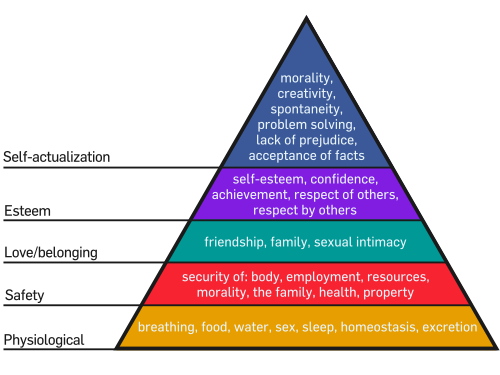
  • Maslow is quite right with the hierarchy of needs.
  • Viktor Frankl was quite right also.
    He has written about man's search for meaning and developed the logotherapy. He basically states that we can discover meaning in life in three different ways: (1) by creating a work or doing a deed; (2) by experiencing a value – nature, a work of art, another person, i.e., love; (3) by the attitude we take toward unavoidable suffering.

  • Be thankful for every help you get.
    Especially doctors often have a negative image, but they really can save your life (or in our case the life of our son).
Related posts: Biggest worries, Knowledge is freedom, The most important things to know, All done status, There is suffering.

2009-11-22

Biggest worries

One of my biggest worries always was to get the children born healthy and sane. Now, with the birth of our second child I am very happy and thankful that both are well.

Thinking of the family I do notice that it is extremely important to me that my loved ones stay well - healthy, sane and happy.

But the other very, very important thing mostly underestimated while everything runs (still) fine: Having a job is a key major need and doing a good job is the best insurance of keeping it.

Remaining without a regular work / day job is one of my key worries. It is a requirement to get settled with your family and have enough money/resources for food, roof, clothes and medical support.

The next biggest worry is that my loved ones get ill, rubbed or knocked down for example. I want to know them being sane and save. Having a good job and enough income is a key requirement to get everything needed for a living.

Although quite logical and most should know, sometimes I have the impression that people's life is so full of things that the most primary priorities lack attention...

Related posts: The most important things to know, Knowledge is freedom, Needs and meaning, The family.

2009-08-04

Something more important

A good while ago I stumbled upon this quote:
Courage is not the absence of fear, but rather the judgment that something else is more important than fear. (Ambrose Redmoon)
I am about to widen this:
Whatever problem might hold you back from success, whatever suffering you face, it might be worth every single step towards a better future.

Thanks to all those who are working honestly and with the best intentions to create a better world for all of us.

Related posts: The fear, Plan to get fear done, The golden rule, Primary motivator.

Unattended mode

While proceeding with your life plans or projects or "simply" building up your personal environment you are establishing services and systems that assist you in being more productive and/or focusing on what you like to do most.

While creating this environment you move your focus from one service or "feature" to another.

So what we do is usually that we pay attention to a thing only during the period when it is created - "installed". Afterwards we tend to consider the thingy to be working. In some cases we remember more or less continuously to check or do some maintenance work.

I am not talking only about technical equipment and infrastructure like heating, light, your PC and all your other devices and gadgets, I am also talking about non-material topics like friendships, partnerships, education of children, inner peace and so on.

Not only when we have finished installing some technical stuff, but also when we have taken decisions or established relationships, we tend to leave it in unattended mode and we forget about the "maintenance work" that is necessary in the long run to keep everything "up and running".

Remember your "civilization goodies" in the way that you pay attention to them once in a while to do a little maintenance work, adjust things a little or "simply" - show a little respect. And pay attention not to commit for too many things!

Related post: Total cost of commitment, Show respect to the team, Respect by attention.

2009-07-29

Analysis and therapy

Whenever I face a new project or a new environment I usually do a lot of analysis, investigation and exploration. This is of course not a bad idea - I mentioned the importance of analysis in several other posts already.

Lately my father was in hospital and they did a lot of exams. But from a particular doctor I learned that a particular test/analysis/exam only makes sense in two circumstances:
  • When there is a therapy indicated on a positive or negative result.
  • When there is scientific interest in knowing that detailed information.

This is a good rule to avoid exaggeration of analysis.

And you can widen this idea in the way that it does not make sense thinking of something if there is no consequence whatever the result is. Keeping this in mind frees you from a lot of "spam thoughts" and reduces your "information overflow".

Related posts: Spam thoughts, Think yourself, Detect the weak point, Focus by decision, Information overflow, Will to change is not enough, The benefit of planning, Early intervention.

2009-06-24

Razor sharp focus

While the economy is undergoing essential changes - which by the way seems to be necessary for this world - you also might want to realign some core elements in your life.

The problem: You are unsure about directions and tend to be undecided.
Especially when many parameters in the environment are unsure many people tend trying to do "business as usual", to follow known rules and well prepared paths. But many of the well known paths and proven strategies now even do not seem a really good choice. What then often happens is that people do switch priorities and goals very often - try this and that and be erratic in their behavior.

The reason: You are full of worries and slightly entering panic mode.
Over the years many things adjusted to each other somehow (more or less automatically). Bigger changes in the environment now do disturb the balance in a significant way. Arising fears are a natural effect. But you should deal with them properly.

The solution: Get informed, dedicate to creativity and evaluation of new ways, choose and focus.
  • Analysis
    Open your eyes and look around - get informed about what is going on around you.
  • Creativity and Evaluation
    Take yourself time to excavate your creativity, evaluate possible solutions and new ways.
  • Choose and focus
    Choose between your alternatives, choose a few important new goals and priorities - this might not be always clear from the arguments. In case of doubt follow your inner voice - your gut feeling.
    Then focus on the very few important new goals and priorities. Command yourself with the words "Razor sharp focus!".
    To have all your priorities served remember to give enough time to each and be patient with step-by-step improvements. Don't expect the fast and big success - "Constant And Never-ending Improvement" is the wise way.
    What then happens while on your way is that you will get critics - this is natural and there might be new arguments, but if you did the analysis and evaluation right then you can be sure that a few critical words of others are not really a reason to change your decisions!
Related posts: Information Overflow, Focus by decision, Focus by direction, Know better and act on it, Total cost of commitment, Time bandits, Why not multitasking how to, Slowing down, New year decisions, The productivity trap, The golden rule, Team meeting with yourself.

2009-04-22

Beware of your routines

First, a short story:
When I woke up this morning, it was already seven o'clock (and I should get up at 6:30). I wondered why I didn't hear the music and found that it must have been my little son playing around there. So I did everything in a hurry, looked at the temperature outside, wondered why it was (still) so fresh outside. Then I wondered why there is so few traffic on the streets. I began to wonder, looked at the time on my watch and on my mobile phone... - I was an hour too early. My son must have been playing around with time adjustment also. :)

At the gas station, when filling the tank I am always trying to get a clean sum of money to avoid to much money changes. This time by mistake I was 2 cents above 45 Euro. From Italy I know that they wouldn't ask me the 2 cents. Here in Austria maybe not. The guy asked me the 2 cents, which I found bad customer service as I know that gas stations make a lot of money here. And there are 2 other gas stations very next to the one where I stop...

Then it happened that a driver on that street apparently woke up in bad mood and showed an aggressive driving style although so few traffic. I had to hit on the breaks to avoid a crash.
This was basically my morning. So, what to learn?

All those things have something in common: There might be a little trigger that cause you to run a complete program automatically without either thinking and/or without any further review.

When going through your routines or while doing "business as usual", it is important to review behavior and processes from time to time - or in single cases. Sometimes it may be worth making exceptions. But people do follow their automatic routines even if it is not appropriate...

2009-04-16

The main purpose

While on the self development path you might get to focus on GTD and then you might find blog posts that propose to focus more on happiness. There is also very much written about the idea to write a life plan.

When I was a boy I was told I need to have goals. But I experienced a lot of suffering because of goals I did not achieve (in the desired time). In the parallel search for meaning I noticed that whatever "higher" purpose I will set in my life, I can always ask for the why and for the next higher purpose and meaning behind it. I was not able to find the one big meaning of mankind and so I decided not to set a particular purpose or goals and just to make optimum use of the opportunities from the point of view when the opportunities show up.

But what is the optimum? Again as there is no big meaning to identify you are free to set whatever priorities you want. However, there are some purposes that are healthy (in the way that they make you feel better) and others are not. I found it a healthy purpose to

help minimizing suffering (in the whole - and not for a single individual).

This is basically what is also mentioned to be logical by Spock in Star Trek (starting with 1:25 in the video):
The needs of many outweigh the needs of a few - or the one.
From time to time we need to remind ourselves to such basic purposes to find realignment in our life.

But what are the needs? Productivity? Happiness? Absence of suffering?

I mean, that you cannot be happy if you don't know what despair and fear is. You cannot know love if you didn't experience hate. Somehow I think that for a "fulfilled" (the word says it) life you need to get many (completely) different experiences. This probably is meant when somebody had a "rich" life. - Not rich of money, but rich of experience and rich of impressions - rich of feelings, rich of views, ...

So when you feel sad or despaired or whatever, just remember that it is giving content to your life. Accept it and feel it fully.

For your decisions and actions remember that principles are more important than rules and the direction is more important than the goal.

Related posts: Principles over rules, Direction over goals, Finding the proper priorities, Between GTD and GHE, Scotty, beam me up, Who? When? For Whom?, There is suffering, Importance of collaboration, Scoundrel days, Living your opportunities, The golden rule, Television, The fool gives way without borders.

2009-03-10

Between short and long term goals

Ever asked what you would do if you get notice that you will only have a few months left to live?

Sometimes when I get notice of critical illnesses around or when I hear from accidents then I ask this question to myself. In personal development blogs I read about how to achieve your dreams to give meaning to your life which I see somehow related.

It is somehow a question how you want to be remembered by
  • your partner
  • your family
  • your friends
  • your colleagues
  • the rest of the world
If you would get notice that you just have some months left, you probably would stay next to your family or - if you are not a family being - you would probably prefer to do something "great" before you die.

Some articles tell, you should focus on these important things NOW.

The problem with this is: If you are not going to die soon then what would you live from in a few months?

My conclusion is: You should think long term in your planning and goals. But you should not invest ALL your time in that. Keep in mind that you will probably never reach your final goals. You might not get to the big outcome when your goal is or your goals are reached, so you should enjoy the journey - in the short and long term context.

But there are things that are independent from long or short term view because it affects both - the eightfold path known from Buddhism (see also at Wikipedia) - known from Buddhism but IMHO is not limited to any particular religion or philosophy.

Related posts: As it would be the last day, The power of intention, Between GTD and GHE, Get focused with 3 questions., In the present moment, The big difference of the How, Principles over rules, Create consensus.

2009-03-06

The time bandits

Although reading and implementing a lot of life hacking methods I get caught within useless meetings or do other work with less outcome than effort. Not talking about the countless interrupts while you are trying to do something important.
Often people learn to focus only in very tough times when there is no option and the focus on that one thing is the only choice to survive. You may know this from learning for exams or starting with an important work - often you start quite in the last moment.

It is sad, annoying and producing either aggression when you hardly try to be efficient and do your best and then others start or continue to waste your time. Others? Why others? If my time is wasted it is me wasting my time, isn't it?

Indeed, it is you wasting your time, but sometimes there are others contributing a lot to navigate you in such situations. Then often you can't really get out easily.

What can you do to avoid getting caught by the time bandits (yes I prefer the word bandit here in favor of thieve)?
  • Never attend a meeting without an agenda!

  • Avoid multitasking. As with computers doing two tasks in parallel means that both tasks get done slower and there is an overhead lost needed for the task switching!
    E. g. Never take the phone or switch to read emails if you are currently working on an important task or on a task that requires your full attention!

  • Have clear and priorities and goals (or direction where you want to go). For whatever comes up that does not meet these commitments define a late schedule.

  • Urge others to be concrete (have concrete goals and priorities). If you can't get concrete information immediately keep asking. Often the get away quickly if you ask the right questions, because they have no idea.

  • Don't jump on hypes just because it's a hype. Do your own critical investigation asking for the big benefit. Often there is no real benefit.

  • Don't start actions as long as others did not take their decisions. You cannot take all decisions for your customers, boss or partners - often it is simply not your job and you are not in the appropriate position. Although it seems to be less effort to take a decision than implementing a project often the decisions take far longer.
    Exception: If it has been declared that you do take all relevant decisions.

  • Learn to ignore things that others deposit on you just to get their mind flushed and cleared (this includes everything from annoying colleagues to news crying for attention.
    Exception: If they really have good and creative ideas.

  • Don't attempt to help others if they do not give the clear statement/commitment that they want to really solve their problem. You can identify such situations by watching the reaction of your first solution proposals or by asking for that commitment prior to further action.

  • Don't take the responsibility for a project that others drove into a mess and then just want to attach the problem to somebody else! You take the responsibility for your actions and others have to take their responsibility.
    Exception: You get hired especially for such an impossible mission and get payed accordingly.

  • Change the environment! Hard to accept, but you simply will never be able to have a power hour if many people are around you and can ask you any stuff by accident.

  • Instruct people that they should ask for your time in advance.
    They should ask for a schedule or at least do not immediately come up with their questions but rather ask before if you have time now. If the question is already told your concentration is gone. But a "No, come back in an hour" can be given automatically without loosing focus.

  • Learn to say "No" or learn to postpone the things that are not really important (procrastination can be useful). Some problems dissolve themselves if you do not disturb them.

Related posts: Time thieves and real news, Change the environment, When changing the environment does not help, Crying for attention, Hot air, Masked rot, Total cost of commitment, Change hype, Focus by direction, Find the root problem, Let 'em wait, Why not multitasking how to, How to rebuff somebody, Tell not more and not less, Razor sharp focus.

2009-02-22

Total cost of commitment

The problem: Available time for new projects is very short.
Although you already invested a lot of effort into strategies to improve productivity, you still have not really much time free for your new ideas or new projects.

The reason: Maintenance work
Our life is full of things created during the progress of mankind. Many very helpful tools have been created, but also many "toys". And we are not limited to things. Because of the progress in IT keeping contact with many people also is possible in a size that never has been possible before (talking about social networking). I lately got back in contact with many old class mates and I would like to meet them all re-vitalizing the relationship. In addition to that I have set several goals during self development and I do play several roles - in the job as well as for my family and friends.

But there is a lot of "maintenance effort" needed to keep everything we use, every relationship and every service "up and running". Many people have their daily life filled up with maintenance tasks.

The solution: Reduce your commitments and life goals - unclutter your life - get less done.
While optimizing your life and finding out that you can get more things done when you start really optimizing, you might tend to set too many goals while creating your life plan and living your dreams. Together with a lot of existing stuff to be managed this may eat more time than available.

Many things, once started, eat up a certain amount of maintenance time/money (even if you are "just" a blogger - there is maintenance work answering comments or searching for advertising options etc.). To start living a big dream might come along with the fact that you have less time left dedicated to your family and friends (just to give an example).

The day has only 24 hours, you can't fill in everything and in the highest quality.
Set only a few clear major priorities/goals and declutter your life accordingly.

Keep in mind, that it is more important to be happy than to achieve something great!

At the end it is important that you enjoyed your life and leave with clear conscience rather than having your name be remembered for a long time after your death.

Review your current life with the appropriate services you are using and providing looking at all the related work that comes along with those. Often it is not easy to identify the whole related maintenance work for a particular thing or service because not occurring in a bunch.

So carefully log or analyze the tasks and time needed to keep your things and services up and running. Put them in relation to the outcome for you. You might find out that several services are not worth it for you. This applies also for every goal and every commitment you have set or taken.

Related posts: Crying for attention, Slowing down, How to be happy, Know better and act on it, Razor sharp focus, The family, Know your options.

2009-02-03

When to strictly avoid multitasking

The problem: Mistakes and errors caused by multitasking
Multitasking often results in mistakes and errors as you forget about a task while occupied with another or because because you get in time trouble and hurry because you loose too much time switching tasks (overhead).

The reason: While multitasking your attention to the single task is reduced.
Often longer lasting tasks involve long waiting times. Although many life hackers warn about multitasking and recommend to avoid it, there are some tasks that continuously ask for multitasking because they are simply very time consuming while not needing the full attention or come along with long waiting times between several actions.

The solution: Only multitask jobs that come to a proper end themselves.
When analyzing my multitasking behavior and the cases where problems occur due to multitasking habit I found out that safe multitasking can only be done for tasks that can be checked at whatever time if they came to a proper end. An important thing is that when multitasking the multiple jobs should not run on same priority. There should be only one active task that has your full attention. Other tasks - those that safely can come to a proper end left on their own - should run as "background task".

Samples for tasks that can be safely run in background:
  • Washing clothes (Washing maschine)
  • Copying files on your computer, burning CDs/DVDs, ...
  • Filling your tank at the gas station (usually can be fixed and it quits automatically when the tank is full)
Samples of tasks that should NOT be run in background:
  • Cooking
    Why not: If you watch the milk to boil it will boil in the moment you look out of the windows.

  • Filling a big bucket of water (inside house)
    Why not: When you forget about the tasks the water runs out on the floor

  • Handling less important phone calls.
    Why not: Even if your mom talks long about something very unimportant the subject might change and suddenly something important is said.
The point is that you should only run tasks in background that you can safely forget about.

Related posts: Why not multitasking how to, Reduce the stress factors.